Little Monk Goes Viral

A little child dressed up as a monk in Fuzhou China has gone viral on Weibo

Robot Monk Unveiled In China

A buddhist temple, Dragon Spring Temple in Beijing, China has developed a robot monk named "XianEr" which was unveiled at the temple's National Day Gala celebration earlier this mont

Steven Seagal To Rebuild Buddhist Temple In Serbia

Steven Seagal Wants To Rebuild Europe's First Buddhist Temple

Buddhist Story - The Dog And The Pet Shop Owner

About A Dog And His Master, A Pet Shop Owner

Get Rid Of Bad Luck

Japanese Style

Showing posts with label country - indonesia. Show all posts

Friday, November 21, 2014

Buddhists Clean Up Streets For New President

To celebrate the appointment of new Indonesian President, Joko Widodo (Jokowi),on October 20, 2014 a group consisting of 65 volunteers from the Buddhist Tzu Chi Fellowship held a rubbish collection session on the streets leading to the National Palace, the venue where the appointment of the new appointment would be held


Clad in their blue and white uniforms and a cap, the volunteers put on hand gloves and went around picking up rubbish in the streets of the country's capital city. According to the group's coordinator, Joe Riady, " We want to keep the capital city clean on the date of the appointment of the President "
They started their work at 10.00am and by they called it a day, 180 bags fulled of rubbish were collected.

Tuesday, December 27, 2011

Indonesian Buddhist Population

According to the national censes conducted in 2010, the population of Indonesian stands at 237,641,326 and of this figure the number of Buddhist numbers 1,703,254 which is 0.72% of the total population.

Facts about Buddhist in Indonesia

- 1,500,475 reside in cities while 202,779 come from villages/rural areas
- DKI Jakarta has the most number of Buddhist with (317,527) or 3.30% of the
city's population
- North Sumatera comes in 2nd place with 303,546 followed by Western Kalimantan and
Banten with 237,741 and 131,222 respectively
- Number of Buddhist in the most western part of Indonesia, Acheh = 7062
- Number of Buddhist in the most eastern part of Indonesia, Papua = 1452
- Province that has the least number of Buddhist is Northern Maluku = 90
- Number of Buddhist in the age group (0-4 year old) = 117,323 or 6.89%
- Number of Buddhist in the age group (5-10 year old) = 132,162 or 7.76%
- Number of Buddhist in the age group (10-14 year old) = 129,950 or 7.63%
- Number of Buddhist in the age group (15-19 year old) = 135,442 or 7.95%
- Number of Buddhist in the age group (20-24 year old) = 143,362 or 8.42%
- Number of Buddhist in the age group (25-29 year old) = 153,338 or 9.0%
- Number of Buddhist in the age group (30-34 year old) = 131,651 or 7.63%
- Number of Buddhist in the age group (35-39 year old) = 115,180 or 6.76%
- Number of Buddhist in the age group (above 60 year old) = 207,550 or
- Male Buddhist (869,097), female Buddhist (834,167)

Thursday, September 1, 2011

Buddhist Personality : Khantidharo

Indonesian Buddhist monk, Khanthidharo Mahathera was christianed as Djamal Bakir, was a staunch Muslim and had a loving wife before he decided to lead a monastic life 24 years ago.


He was born on July 17, 1931 in a small village located on the Merbabu volcano in Magelang, Indonesia. The 5th of 9 siblings in the family , he was known to be the more sociable and intelligent one among his siblings. In 1952, he became a teacher in a secondary school in Medan, Sumatera but returned to Jateng near his hometown two years later to continue his study while teaching part time in a secondary school There he met a fellow female teacher Sri Hartini and got married to hear on July 17, 1955. Djmaal continued his studies and was awarded a doctorate degree in Economics in 1963. He became a banker in the morning and taught at a school in Magelang in the evening. During that period of his life, he came in contact with Buddhism and was fascinated with the teachings of Dhamma. He encouraged his wife to read books on Dhamma and together, the couple became active devotees in a temple, Dhammadipa Arama. In 1971, he was appointed to lead the Perhimpunan Buddhis Indonesia (PERBUDHI) a Buddhist based association. This appointment marked the turning point of his life as a Buddhist as he learned more on Buddhism and became a writer of the Dhamma for a montly Buddhist magazine from 1971 to 1977. Later, he travelled to Myanmar, became a staff of the Indonesia Embassy there while furthering his knowledge in Buddhism. In 1982, he went for a religious journey with his wife to India and upon his returned worked as the General Director of the Education and Cultural Department for 5 years, travelling extensively to all 27 provinces in the country. Despite his respectable position in the government service, he started to comtemplate to dedicate his life follow the Dhamma path. Finally on Decebmer 6, 1987, he was ordained as a monk and adopted a monastic name of Khantidharo


Today he is the chief monk of the Dhammadipa Buddhist Vihara in Malang, Jawa, Indonesia and recently celebrated his 80th birthday.


Saturday, August 27, 2011

Indonesian Buddhists To Visit Sri Lanka

After a quarter-century of civil war ended in May 2009, Sri Lanka is back on track to lure investors and tourists. More than 100 Buddhist pilgrims from Indonesia will visit the island state this weekend, a Sri Lankan envoy says.

“For the first time, a large number of Indonesian Buddhists are going to visit Buddhist shrines in Sri Lanka. This tour was arranged by Hadaya Vatthu Foundation president Charles Hardono,” Sri Lankan Ambassador to Indonesia Maj. Gen. Nanda Mallawaarachchi told The Jakarta Post on August 26, 2011.

“The Sri Lankan Tourism Promotion Bureau has made special preparations to welcome them in Sri Lanka. I think it’s the right time, as Buddhists all over the world are celebrating the 2600th Sambuddha Jayanthi this year”.

Buddhists constitute around 1 percent of the population in Indonesia. Home to the world’s largest Muslim population, Indonesia also boasts the world’s largest Buddhist temple, Borobudur, a UNESCO world heritage site.

From the political point of view, Ambassador Nanda said, now was the right time as well.

Friday, August 26, 2011

Rice Of Love

On August 21, 2011, volunteers from Tzu Chi Foundation, Taiwan, held a rice sharing event in Tambora , Jakarta Barat, the capital city of Indonesia.

In her letter dedicated to Indonesians, Master Cheng Yen, the founder of Tzu Chi said that sharing of rice will end at one point ( when all rice have been distributed ) but the blessings and love in them shall remain forever.

The Governor of DKI Jakarta, Fauzi Bowo thanked Tzu Chi for it's noble act of sharing the "rice of love" with people of Jakarta. Fauzi had participated in events organized by Tzu Chi Indonesia in the past.
.
Distribution of rice started at 8am. The scorching morning sun did not dampen the spirits of the 178 volunteers on duty that morning but instead they continued to distribute a total of 3027 bags of rice and cooking oil with smiles on their faces. Recipients were given coupons to be exchanged with rice prior to that, on August 14, 2011. Besides rice and cooking oil, volunteers also handed essential items to families nearby whose 9 houses were burnt down on August 13, 2011.

One of the recipients was a 83 years old woman, Liem Lit Nio who lives in a house repaired by Tzu Chi in 2003 with 36 of her family members. Back then while going round surveying the area, Tzu Chi volunteers discovered the dilapidated house of Liem and found that it was not in a good state and decided to help her repair her house. Madam Liem thanked Tzu Chi continously for not only rebuilt her house but also shared the "rice of love" with her family.

In the spirit of sharing, in return Madam Liem gave away her fully filled money saving container made from bamboo to Tzu Chi. She said that even though the amount was not big but she shared it with the others a big heart referring to the quote by Master Cheng Yen that " sharing with the others allows us to feel blessed and satisfy with what we already have "


Madam Liem's making her own contribution


Tuesday, June 28, 2011

Richard Gere Visits Borobodur

Richard Gere meditated at Indonesia's Borobudur temple on June 27, 2011 before touring the ninth-century Buddhist monument with his wife and son.

"He meditated for 20 minutes this morning at the top platform and made a 45-minute tour to admire the details of the temple's reliefs," temple manager Purnomo Siswo Prasetyo.


He said Gere was "astonished" with the grandeur of the so-called temple mountain, which lies between two volcanoes about 40 kilometres (25 miles) northwest of Yogyakarta.
One of the peaks, Merapi, killed more than 320 people last year in its biggest eruptions in over a century.
The temple was abandoned with the spread of Islam on Java island in the 14th century, but was "rediscovered" in 1814 by English trader Sir Thomas Stamford Raffles.

Restored with the help of UNESCO in the 1970s, it is now Indonesia's most-visited tourist attraction, drawing about 3.8 million people last year, according to Prasetyo.

"Yes, the crowded atmosphere made Richard unable to enjoy. He was not comfortable with the many photographers and the media who followed him." said President Director of PT Taman Wisata Candi Borobudur, Prambanan and Ratu Boko , Purnomo Siswo Prasetya, after accompanying Richard at Borobudur Temple

Purnomo said the bodhi tree planting agenda by Richard is an event initiated by PT Taman Wisata Candi Borobudur Tourism Park, Prambanan and Ratu Boko in cooperation with UNESCO.

Feeling uncomfortable, Gere decided to cancel the bodhi tree planting in the courtyard of the east side of the largest temples. Gere arrived at the temple at around 4:30 pm. He then immediately climbed onto the top or the main stupa of Borobudur to see the sights. After that followed pradaksina, namely to respect the rituals around the temple.

Gere, a 61-year-old convert to Buddhism, arrived in Indonesia on June 26, 2011 on what he called a "spiritual journey".

Initially he was expected to plant a bodhi tree at the temple's compound but the plan was later cancelled due big crowded atmosphere.

He met President Susilo Bambang Yudhoyono at the state palace in Jakarta and told local media he was thinking of making a film about the history of the temple.

He would be going to the Indonesian resort island of Bali for a holiday with his family.

The American visited the Jogye temple in central Seoul, South Korea, last week.

Wednesday, May 18, 2011

Photo Gallery - Vesak Celebration

In Bodhgaya, India


In Phnom Penh, Cambodia


In Bangkok, Thailand


In Yangon, Myanmar


In Hanoi, Vietnam


In Central Jawa, Indonesia


In Kathmandu, Nepal


In Colombo, Sri Lanka


In Seoul, Korea


In Singapore


Vesak Celebration at Borobodur Temple in Magelang, Indonesia on May 17, 2011


In Penang, Malaysia


In Kuala Lumpur, Malaysia

Saturday, May 7, 2011

No More Buddha Bar In Jakarta

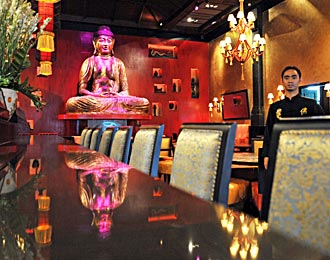
After much protest from the Buddhist community, the owner of the Buddha Bar in Jakarta has decided to change it's name to Bistro Boulevard and the large Buddha statue inside the bar would be removed from the bar and sent to a Buddhist Vihara in Centre Jawa.

My earlier posts on this controversy here , here and here

A spokeswoman for the bar said " We have decided to send the large Buddha statue inside the bar to Yayasan Walubi, a Buddhist vihara. This is the best move to end this controversy "


The 4 meter Buddha statue, a symbol of the Buddha Bar was removed from the 2nd floor of the restaurant by 6 male adults after being separated into two parts.

The management of the Buddha Bar in Jakarta, PT Nireta Vista Creative has decided to end its franchise agreement with the Buddha Bar franchiser in France and adopted a new concept to avoid this controversy to deteriorate and to maintain religious harmony in the country.

Bistro Boulevard had its soft opening on April 18, 2011. The management has also created a new website in line with the new concept of the restaurant

The new website

Friday, April 15, 2011

Removal Of Buddha Statue In Indonesia

The Religious Affairs Ministry has ordered a large Buddhist statue in North Sumatra to be taken down after it raised the ire of Muslims in the area.

The problem in North Sumatra started after a number of people calling themselves GIB / Gerakan Islam Bersatu (United Islamic Movement) began to consider the Buddha statue in Tri Ratna a threat to Islamic faith in the city. They argued that the statue could upstage the city's historical symbol ‘Balai di Ujung Tanduk' located in front of it


Budi Setiawan, the ministry’s director general of Buddhist affairs, said that the decision to remove the six-meter-high statue in Tanjung Balai was final and could not be appealed.

He said discussions in October among Buddhists, the Indonesian Council of Ulema (MUI) and the local government resulted in an agreement to dismount the figure, which sat on top of a three-story temple in Vihara Tri Ratna Kota. This claim, however, has been disputed by the Buddhists.

Veryanto Sitohang, head of the Buddhist United Alliance of North Sumatra (ASB), condemned the decision , saying it “clearly violated human rights and law” by siding with Muslims.

Sunday, January 16, 2011

ID & Religion - Indonesia

An Indonesian ID card, like any other around the world, tells who you are, but here it also identifies what you believe in, which can be a source of trouble if you’re a member of a faith that the state does not recognize.

Believers who do not subscribe to the six state-recognized religions will tell you this is not something they can take lightly, particularly during the birth of a child, a marriage or registering for schooling. Regulations on civil registration can prevent some from getting their rights as citizens if their are true to their religions.

“I didn’t care about ID cards until I wanted to get married,” Asep Setia Pujanegara, who has faced many challenges because of his Kaharingan religion, said at a discussion in Jakarta last week.

The 40-year-old said he had filed a complaint against Bandung’s Civil Registration Agency in 2001 for refusing to register his marriage because he was not a member of one of the six approved religions.

He says the legal process took more than six years and that he “only received a copy of the Supreme Court ruling in February 2008, even though the ruling itself was issued in March 2006.”

“During the process, my wife gave birth to our first son in September 2003. Since our marriage was, at that time, not acknowledged by the state, our son’s birth certificate only recognized my wife as his official parent.”

With the ruling in hand, the couple registered their marriage and asked authorities to amend their child’s birth records.

“That experience taught me and everyone I know that to get justice in this country, if you are a believer of an [unrecognized] faith group, one has to go through a long and complicated process.”

“It also had a social and psychological impact on me, because members of my faith group were told to always be compliant to the state. They told us that we were hare-brained,” Asep said.

Under the Constitution, only Islam, Buddhism, Hinduism, Catholicism, Protestantism and Confucianism are recognized and protected by the state. The law makes it illegal to “publicize, recommend or organize public support” for other religions or non-orthodox versions of the approved faiths.

Jakarta resident Prayogo Al Kelik, a member of the Ajisaka faith, said the government had simply put the word “group” next to the religion category when he renewed his ID card last year.

“Previously it was only a hyphen in brackets. My wife even has ‘faith’ listed as her religion. So together we form a ‘faith group,’ ” he said with a laugh.

Asep said different interpretations of the law made at the local level made it difficult for people from unrecognized faith groups to register events such as child births and marriages.

“A pattern of institutionalized discrimination starts right from the beginning, when you apply for an ID card,” said Febi Yonesta of the Jakarta Legal Aid Foundation (LBH).

“Some people recommend that ‘religion’ be removed altogether from the ID card. We used to have ‘tribe’ on the cards before, but now we don’t. So why can’t we do the same with religion and remove it altogether?”

Gendro Nurhadi, head of the traditional faith group directorate at the Ministry of Culture and Tourism, acknowledged that he had received complaints from unrecognized religious groups who tried to register themselves at local administration offices.

“I would like to see where the discussion is heading. When a [decree on public administration] was issued nearly four years ago, it said the government would leave the religion section of ID cards blank in such cases. But now we see that doesn’t work on the ground,” he said.

According to Gendro, in the 1980s there were about 250 different faith groups in Indonesia.

“But we never updated the number. My directorate is trying to update our database. It’s been three years since the project began and we plan to finish it in another three years,” he said.

In theory, Indonesia acknowledges the existence of other faith groups alongside the six religions, but this is seldom true in practice. These faith groups fall under the jurisdiction of Ministry of Culture and Tourism.

Gendro also said that only traditional faith groups that have clear historical origin are recognized by the state.

Kristin Lilik, an official from the Ministry of Home Affairs, said the 2006 Law on Public Administration explained how those who did not adhere to one of the six religions could still be acknowledged as citizens.

“I perceived this as a localized problem, which we would follow through and remind people about at the local levels. Members of these groups could also ask for a statement from the local registration office if they fear being recognized as atheists,” she said.

Tuesday, October 5, 2010

Monks Gathering In Indonesia

On September 26, 2010, more than 200 monks from around the world gathered in the city of Semarang in Central Java, Indonesia to attend the World Chinese Buddhist Congress Executive Meeting. The meeting was officially opened by the mayor of the city, Sumarmo Hadi Saputro.

The chairman of the congres Wang Hui in his opening speech introduced Indonesia as a multi etnic and multi religious country where everyone regarding of religions respect each other to ensure social stability and harmony in the country.

He said the World Chinese Buddhist Congress would work closely with Indonesian Buddhist to enable them to learn and to practice the Dhamma as well as to promote globalization of Buddhism. The Congress had made some significant contributions to Indonesia in the past. In 2005, it constructed more than 200 homes and roads in remote areas for the victims of Tsunami in Aceh. It also held mass prayers to pray for no further misfortunes in Indonesia.

This is the 3rd time, the Congress which was established in 1965 had it's meeting in Indonesia, the first time in Jakarta in 1995 and followed by Bali in 2006.

After the meeting, the monks were feted with a dinner hosted by the Governor of Central Java, Bibit Waluyo which was also attended by several civil and army personnels. The delegates were also entertained with performances of traditional Indonesian dances during the dinner. The following morning, the delegates were taken to visit the world famous Borobodur.

Friday, October 1, 2010

Indonesian Buddhist College Graduation Ceremony

On September 25, 2010, the Sriwijaya State College Of Buddhism held it's 4th graduation ceremony in Tangerang, Indonesia. 27 graduates from Central Java, East Java, Lampung, Palembang, Kalimantan and Sulawesi received their rolls during the ceremony. The college had also accepted 84 new students for it's new semester.