Little Monk Goes Viral

A little child dressed up as a monk in Fuzhou China has gone viral on Weibo

Robot Monk Unveiled In China

A buddhist temple, Dragon Spring Temple in Beijing, China has developed a robot monk named "XianEr" which was unveiled at the temple's National Day Gala celebration earlier this mont

Steven Seagal To Rebuild Buddhist Temple In Serbia

Steven Seagal Wants To Rebuild Europe's First Buddhist Temple

Buddhist Story - The Dog And The Pet Shop Owner

About A Dog And His Master, A Pet Shop Owner

Get Rid Of Bad Luck

Japanese Style

Showing posts with label category - story. Show all posts

Wednesday, August 31, 2011

Real Story - A Kind Hearted Man And His Handicapped Pig

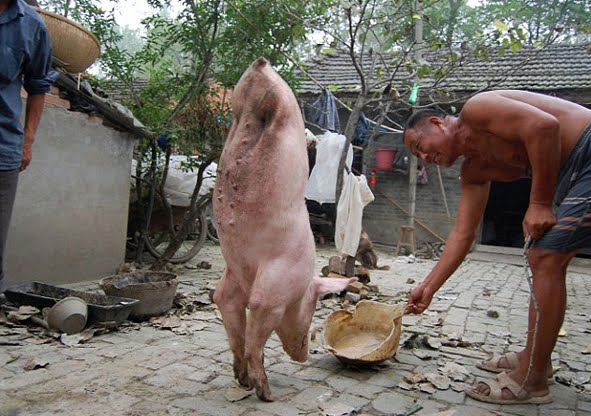
This is a real story about a man and his handicapped pig. The sow born with two legs and named Zhu Jianqiang, literally means brave and strong in Chinese belongs to a villager, Mr Wang Xihai who lives in Henan Province in China.

When Zhu Jianqiang was born almost 18 months ago, Mr Wang's wife had wanted to throw her away but was stopped by Mr Wang. He told his wife that despite the piglet's handicapped, she deserved to be given a chance to live on. The kind hearted Mr Wang however admitted that he didn't expect Zhu Jianqiang to live long and healthy as she is today.

Zhu Jianqiang was one of nine piglets born and she was the only handicapped one, born with two legs. A few days after she was born, Mr Wang decided to teach her to walk by lifting her by the tail. She was trained to walk for a short period everyday and by 30 days she was able to walk upside down.

Not long after that, the news about Zhu Jianqiang became the talk of the village and Mr Wang's house was visited by many people, some of them even offered hefty prices to purchase the pig but was flatly declined by Mr Wang.

Mr Wang said that Zhu Jianqiang determination to live despite her handicapped reminds us not to give up on our lives no matter how difficult our lives are and it is because of this that he would never sell Zhu Jianqiang to anyone.

Moral of the above story - When the world whispers to us " give up " and " not impossible ", our little heart shouts " you can do it ".


Friday, August 26, 2011

Buddha's Life Story


Friday, November 12, 2010

Buddhist Story - The Eleven Pigs

Once upon a time there lived a butcher in a small village in China. Everyday he would kill a pig to supply the demand for the people who lived around him. However, slaughtering pigs was an act of killing sentient beings Therefore he often thought of making a living out of other profession,

I should change my profession! There are many jobs I can do out. Why should I be a butcher? My knife has to kill a pig and "dye red" each day. If I kill 20 pigs each month then I would have killed 260 pigs every year. It’‘s terrible whenever time I think about it."


However, the butcher had a family to feed. Slaughtering pigs was a profession that he could made money with ease. Therefore his thought of changing profession became replaced by another thought. He would reassured himself,

"Oh well, well! Changing profession is not that easy, is it? Furthermore it isn’‘t me who like killing pigs. It’s the people who like to eat pork. Otherwise who will I sell to when I kill them? Even though I incur bad retribution, those who eat pork should also share the responsibilities with me as well. Also we keep pigs because we want to eat them, don’‘t we?!!"

Since he had to arrive at the morning market early, and also pigs made tremendous noise when he killed them, therefore he chose to slaughter them at dawn. The butcher also had a habit which he had been keeping up for years. That was: Every morning as soon as he heard the bell rang from the nearby Buddhist temple, he would get up and slaughtered a pig. This habitual action had never changed.

However, one day he got up late. Later he found out that the temple did not ring the bell at all in that morning. When the butcher went to the pig-shed he discovered the mother pig he was going to kill gave birth to 11 sucking-pigs in the morning. Everyone of them was so fat and already they were leaning so close to the mother and suckling for milk. How lovely they were! He felt the event was extraordinary.

Therefore he went to the temple. The abbot of the temple told him,

"I had a dream last night. I dreamed of 11 children who knelt down to beg me to save the life of their mother.

I asked them how I could save her. They replied it was very simple. All I needed to do was not to ring the bell."

Eleven children? Eleven pigs? Suddenly the butcher understood the relationship between them. He threw the knife he killed the pigs into the river. Eventually he determined to change his profession

Thursday, August 5, 2010

Buddhist Parable : An Empty Cup

Once there was a university professor who had an extensive background in Zen and Buddhism went to visit with a Zen master to discuss and learn things of a Zen nature from the master.


While they talked, it became clear to the Zen master that the professor considered himself quite knowledgeable on the subject of Zen and Buddhism, going on and on about various related topics. The Zen master listened, and then offered tea. He went to fetch the tea pot and cups and set one before the professor.

The Zen master began pouring tea while the professor continued talking, but when the cup became full to the brim, the Zen master continued pouring. Tea spilled over the edge and all over the table!

"Stop, what are you doing?!" the professor spoke, interrupting himself. "Can't you see that the cup is full?"

"You are like this cup," the Zen master explained. "You are so full of information that nothing more gets in. You came here to discuss Zen, but how can I show you what is Zen if you do not first empty your up?"

The professor thought for a moment and became silent, ready then to receive lessons from the Zen master.

Moral of the story is, we should not be too enamored and trapped by our own ideas and opinions until we disallow new ones to get into us.

Monday, July 26, 2010

Buddhist Parables

Buddha's teachings are written in the sutra but it is not easy to read and comprehend the sutras. Buddhist Parables are Buddha's teachings told in laymen words and they are easy to understand. The following is one of them.

A man once came to see the Buddha to get help with his problems. After the man had told the Buddha one of his problems and asked for help, the Buddha replied: "I cannot help you get rid of that problem."

The man was surprised that the Buddha could not help him in this regard, but he told the Buddha about another problem; he thought to himself that the Buddha should at least be able to help him with that problem. But the Buddha told him "I cannot help you with that problem either."

The man started to get impatient. He said: "How can it be that you are the perfectly Enlightened Buddha, when you can’t even help people get rid of their problems?" The Buddha answered: "You will always have 83 problems in your life. Sometimes a problem will go, but then another problem will come. I cannot help you with that."

The baffled man asked the Buddha: "But, what can you help me with, then?" The Buddha replied: "I can help you get rid of your 84th problem." The man asked: "But what is my 84th problem?" The Buddha replied: "That you don't want to have any problems"


Moral of the story. Men and problems cannot be separated but like everything else these problems are impermanent. We should not feel worry or be bothered by each and every problems that we have. Face the problems with a positive outlook and be relax.

Thursday, March 19, 2009

Story Of The Buddha & Buddhism ( Part 57 - 60 ) - Final


The third Buddhist council being held with the venerable Moggaliputta Tissa as the presiding Thera

King Dhammasoka understood the essence of Buddhism, and gave great support to the cause of Buddhism by erecting rock-edicts in all parts of his territory enjoining upon the subjects to follow the Doctrine in their daily lives. With his royal patronage Buddhism flourished, and the Sasana gradually grew in importance and numbers. Tempted by worldly gain, many undesirables of alien sects joined the Order and polluted the Sasana by their corrupt lives and heretical views which they taught.

Good monks could not live together with these sham monks and there was trouble. The King consulted the Venerable Moggaliputta Tissa to protect the Sasana. The King tested the monks and disrobed the undesirables to purify the Sasana. The third Buddhist Council was then held by 1000 Arahants, with the Venerable Moggaliputta Tissa as the presiding Thera.


King Vattagamani Abhaya being accompanied by monks in marching out with his army to the battle-front

King Vattagamani Abhaya was a staunch supporter and defender of the Buddhist religion in the island of Lanka (Ceylon). One day when he was about to go out to fight the Tamil Kings, the King went to the monastery and said to the Mahathers, "Venerable Sirs, I shall have to go across the Ganga (the river) to promote the cause of Buddhism, and wise the Theras to accompany me on my journeys so that I can pay my respects to them at all times"

The Mahatheras selected 500 monks who were in their prime of life and sent them to accompany the King. King Vattagamani carried on battle while at the same time attanding to the personal needs of the Theras in his company with regard to their food, medicine,etc. The spare used by the King contained a sacred relic of the Buddha embedded in it at its end. His motto runs thus:-"I have been doing my best to make Buddhism last long and not for my own personal gain.


The Tipitaka being committed to writing on Ola (palm) leaves during the reign of King Vattagamani Abhaya

From the time of Buddha's life down to the time of King Vattagamani's reign, the Tipitaka forming the teachings of the Blessed One were handed down from generation to generation of monks by word of mouth, by being learnt by heart. During the region of King Vattagamani, however, trouble was given by Brahmana Tissa, who rose up in arms and there was also inference from Kings who were disbelievers in the Buddhist religion. The monks could not get enough food for their meals and had to make extraordinary efforts to retain in memory whatever parts of the Buddhist scriptures the had already learnt by heart.

This was a matter for anxiety as, if the monks in future could not commit the Tipitaka scriptures to memory and recite them, the scriptures might disappear altogether. They therefore sought the assistance of King Vattagamani and held the Fourth Buddhist Council by committing the Tipitaka to writing on ola (palm) leaves.

The expression "Writing committed to palm leaves" has come into usage with reference to this first act of the letters of the alphabet being written down on ola (palm) leaves.


Anawratha of Bagan conveying the Buddhist scriptures

King Anawratha of Bagan conveyed the Buddhist Scriptures from Thaton to Pagan for the benefit of all beings. He then removed the frontal bone, sacred relic of the Buddha, from Kaung-hmu-daw pagoda at Prome built by King Dutta-baung and took it also to Pagan. On arrival there he built a pagoda on the sand-bank of the Irrawaddy river near Pagan and enshrined the frontal bone of the Buddha there. When the third terrace of this pagoda was constructed, he brought a replica of the Buddha's tooth from Sri Lanka and enshrined it also in this pagoda. Before the construction of this pagoda was completed King Anawratha died.

When Kyanzittha became King of Pagan in succession to Anawratha, he continued to build this pagoda as advised by the Venerable Arahan. This pagoda was known as Shwezigon (Golden Sandbank) pagoda because it stands upon a stripof sand bank. King Anawratha started its construction in 393 Bur. E. (1033 C.E.) and Kyanzittha continued to build it and hoisted a golden hti (crown) on it in 452 Bur.E. (1192 C.E.).

Wednesday, March 18, 2009

Story Of The Buddha & Buddhism ( Part 53 - 56 )

Part 53

Dona, the professor, distributing the sacred relics Of the Buddha to the rules of eight states

Just before the Buddha passed away, he made a resolute wish that, "the bones of my body may be left over as relics in small bits" so that posterity may reverence them. Ajatasattu and other rulers heard of the Buddha's death and came out with their own armies to fight for the possession of the sacred relics of the Buddha, if they should fail to get them by peaceful means. Dona the Brahmin was a virtuous professor who happened to have been a teacher of those rulers.

There was a great excitement and disorder amongst the crowds present who were preparing to loot the relics. Now Professor Dona got up on an eminence and shouted at the crowd in an authoritative tone, when the din was silenced. Then he spoke to the crowd beginning with the words, "Listen to me, your teacher. Our Lord, the Buddha, used to preach on forbearance";. Then as agreed by the rulers of the eight states, the Professor distributed the sacred relics to them. They took the relics away and placed them inside pagodas and shrines and revered them as objects of worship.

Part 54

The First Buddhist Council

About seven days after the Buddha had passed away, the Venerable Mahakassapa heard of His death, while he was resting on his way from Pava to Kusinara together with 500 Theras. All the junior Theras were plunged in deep grief and were weeping and lamenting. But a monk named Subhadda, who had entered the Order in his old age, was the only one that rejoiced over His death. "Grieve not, brothers" he said, "weep not, we are now delivered of that Great Ascetic. He constantly worried us, saying ' This is proper, this is not proper'. Now we are free to do what we like"

These unexpected words that fell from the lips of a disciple alarmed the Venerable Mahakassapa who became very concerned about the future of the Buddha's religious system, but kept quiet. When the Buddha's relics had been distributed, the Venerable Mahakassapa consulted the other Theras and suggested to them to hold a Council of leading Arahants to collect, classify and rehearse the teachings of the Buddha in order to protect and fortify the Sasana against such attacks as might be expected from monks of the type of Subhadda. They all welcomed the suggestion. King Ajatasattu was informed of the intention of the Samgha, and with his help the First Buddhist council was held at Rajagaha with 500 Arahants.


Part 55

Venerable Yasa's efforts to hold the second Buddhist council for the offense of monks collecting money

About 100 years after the death of the Buddha, monks of the Vajji clan did certain acts which were not becoming of monks. They begged for money, even an anna (a nickel) or two, from lay devotees who came to the monastery on Uposatha days to keep their precepts. The Venerable Yasa then said that it was not fit for monks to handle money. For that reason, they imposed a Vinaya Act on the Venerable Yasa by which it was made obligatory for the person who said so to tender an apology to lay devotees for alleged interference with their charitable motives.

The Venerable Yasa went to the lay devotees and explained the true purport of the Buddha's teachings; and when the lay devotes understood it they showed no further respect to monks who begged for alms in cash. The Venerable Yasa approached the distinguished Arahants and asked them to adjudge the matter, and they pronounced that it was not lawful according to the Vinaya for monks to handle money. After which, 700 distinguished Arahants were chosen and the Second Buddhist Council was held to protect the Doctrine.

Part 56

King Asoka offering meal to young novice Nigrodha who sat upon the throne

King Asoka regularly fed the Brahmin priests, in accordance with the custom of the royal household, before his conversion to Buddhism. But he was not pleased with their demeanour at meal-time, as they were neither clean nor calm. The King thought to himself, "Charity on such a lavish scale should be given in proper quarters". Later, one day he saw a serene-looking young novice, quietly walking along the street with restrained senses.

The King was so impressed with the deportment that the novice was invited to the palace at once and requested to occupy a suitable seat; and the novice went up the throne and sat on it. The King then served him with and excellent meal and asked him to give an exposition of the Doctrine which his Teacher used to preach. The young novice Nigrodha delivered an instructive discourse on the following stanza of the Dhammapada:-

"Heedfulness is the path to Deathlessness. Heedlessness is the path to death. The heedful do not die, the heedless are like unto the dead".

The word of the Buddha appealed to him and he became a Buddhist and staunch supporter of the religion

Story Of The Buddha & Buddhism ( Part 49 - 52 )

Part 49

The blessed one taming Nalagiri elephant which was sent to crush him

After the death of King Bimbisara, Devadatta made several attempts to kill the Buddha, but he was not successful. So he went to the elephant-keepers and said to them. "Venerable Theras like us who are recognized by the King can use our influence to get you promotion in your service. Therefore, you had better carry out my instructions. If the Venerable Gotama should pass this way, set the full grown male elephant, Nalagiri, upon Him".

Nalagiri was a very ferocious elephant which used to gore men to death. The Blessed One, with his retinue of holy monks, was coming into the city of Rajagaha on his alms-round, when the elephant-keepers, desirous of gaining promotion in service, set the full-grown elephant in the direction of the Buddha. The Blessed One stood where he was and sent out his thought of loving-kindness towards the elephants Nalagiri, which was running towards him to crush him down. When the elephant came near the Buddha, it stood quietly before Him listening to the words of advice uttered by him.

Part 50

King Ajatasattu coming out to pay his respects to the Buddha and his disciples

After the death of his father, King Bimbisara, King Ajatasattu could not sleep well and used to wake up with a start. He wanted to go to the Buddha so as to get some mental relief, but he dared not go because he had done the most heinous act of parricide. On the night of the courtiers as follows:- "Whom shall I approach on such a pleasant night in order to have a clear and peaceful mind?"

The countries made several suggestions to him but he did not accept any of them. He took the suggestion of the Physician Jivaka, and left the city with a city with a procession of five hundred female elephants, fully bedecked and caparisoned, and mounted by five hundred women disguised in the dress of soldiers; and accompanied by torch-bearers to show the way. When he arrived at the Mango Park of Jivaka, he saw the Blessed One and over one thousand holy monks so quiet and peaceful that the sight at once filled his mind with peace and hope.


Part 51

Venerable Kumara Kassapa explaining to the Governor of Payasi the existence of a future world

The Governor of Payasi was of the wrong belief that there was no future world, that there were no such beings as higher and lower gods produced without any apparent cause, that there was no such thing as Hell and that there were no effects of good or bad deeds done. According to his view "if a man dies he is not reborn". Venerable Kumara Kassapa was an Arahant who could preach well. The Governor of Payasi with a great crowd of men came to the Arahant and stated to him his religious views.

Venerable Kumara Kassapa pointed out to him the sun and the moon and asked him, "Are the sun and the moon you see over there in this or another world? Are the beings living there human or celestial?"; The Governor could not answer that the sun and the moon were in this world; nor could he say that their inhabitants were human beings. He had, therefore, to admit that "those planets are in another world land their inhabitants are celestial beings". He was converted from his wrong faith by being asked questions of this nature

Part 52

Parinibbana (death) of the Buddha In the Sala grove of Kusinara State

From His 35th year, the date of His Enlightenment, the Buddha's successful ministry lasted 45 years. When He attained His 80th year the Buddha had an attack of dysentery and lay down on a couch with its head to the north between twin sal-trees in the Sala Grove of Kusinara State. Men, higher and lower gods and monks were gathered, in large numbers, near the Blessed One in respectful adoration.

Though he was very weak and weary, the Buddha was still addressing those present with words of exhortation. After addressing them the whole night Blessed One spoke His last words, when it was nearing dawn, as follows:- "Behold, O disciples, I exhort you. Subject to decay are all conditioned things. Strive on with heedfulness". The Buddha then attained the Ecstasies and arrived at the cessation of perception and sensation, and finally the Blessed One passed away; and there was an earthquake to mark His death