A buddhist temple, Dragon Spring Temple in Beijing, China has developed a robot monk named "XianEr" which was unveiled at the temple's National Day Gala celebration earlier this mont
Eventhough the following videos were produced in China but you don't need to know Chinese to understand and grasp the messages in these videos because there is no dialog used at all. There are just 2 Simple and yet nice to watch videos. Enjoy them !.
Nawang Khechog is a Grammy nominee and one of Tibet's formost world music composer and musician. He is also one of the first Tibetan musicians to be able to break into international world music scene with his original and authentic musical compositions (solo and collaborative albums) to be distributed around the world through different record label. In 2007 Nawang received Tibetan Music Award ( Special Recognition , similar to Life Time Achievement Award) and International Civil Golden Award , The highest civilian award of Nepal.
Nawang was a monk for 11 years and studied Buddhist philosophy and meditation with His Holiness the Dalai Lama and many other Tibetan masters. He also lived as hermit, meditating in the Himalayan foothills for several years under the guidance of His Holiness
Nawang was born into a nomadic family in Eastern Tibet, on a high mountain plateau, where trees can not grow and the wind whispers through the grasslands. He learned about life's lessons and survival at an early age. When he was only three years old, a yogi meditator convinced his father that it would be devastating for their family to remain in Tibet, so they fled the land. the family travelled thousands of miles to India on the backs of yaks. Following a treacherous three year journey, the yogi's prediction came true in 1959, when China took over Tibet. Nawang's family still suffered - most of his family, including his two younger sisters perished in the hot climate of India
Later, he emigrated to Australia, where he heard the soundtrack to the film, "Silk Road," by Japanese synthesizer musician Kitaro. After moving to the United States and launching his own performing career, Khechog was thrilled when Kitaro asked him to perform together for a benefit concert.
"Then he asked me to join his world tour. I said yes. I had been his fan since I heard the 'Silk Road' music," he says.
He then moved from New York to the Boulder area to be near his new musical collaborator, who lived for many years in the mountains in nearby Ward.
"I love Colorado so much. I said, 'Hey, this is it.' I never went back to New York," Khechog says.
Since coming to the United States, he has performed with a veritable who's who of contemporary musicians, including Philip Glass, Trey Anastasio of Phish, David Bowie, Michael Stipe of R.E.M., R. Carlos Nakai, Beastie Boys, U2, A Tribe Called Quest and Pearl Jam.
In 2008, he suffered a severe brain injury in a car accident in India in which his niece was killed. And upon returning to the United States, the 57-year-old experienced a heart attack, He also gives workshops in "Awakening Kindness" around the country.
This month, Nawong will hold a concert to commenmorate the September 11 terrorist attack. Due to his brain injury and heart attack, he hasn't performed in years. For his Sept. 11 concert (see box for details), he'll use instruments from around the world -- a South American flute, Tibetan wind instruments, ocarinas, a "nose flute" from Hawaii, an Australian didgeridoo
Still a practicing Buddhist, Khechog dispels the notion that a non-violent way of living entirely precludes the necessity for fighting. The Sept. 11 attacks, he says, are one example.
"For Buddhism we believe in Buddhist, compassionate, non-violent approach. But we also believe that you can't sometimes just totally be non-violent and peaceful. Sometimes you have to be a little bit tough," he says. Osama bin Laden, Khechog says, deserved compassion, but also "he had to die; he can't be alive."
But, he says, the hurt and horror of Sept. 11 should not become fuel for vengeance, anger or hatred. Just the opposite, in fact.
"The most important lesson to learn out of Sept. 11 is to become more kind and compassionate and loving," he says
Suresh Subramaniam, a 20 year of Indian-Chinese parentage from the Ti-Ratana's Children Home, Malaysia has made the home proud by being the first non-chinese to master the ancient Chinese art of Face Changing. Ti-Ratana is a welfare society founded by Buddhist monk, Chief Rev. K.Dhammaratana in 1994. Suresh is one of the earliest resident of the Children Home. Suresh who is currently a student of 3D Animation in a local college, has keen interest in magic.
Noting Suresh’s keen interest in magic, Ti-Ratana Welfare Society vice-president Tan Thim Huat suggested that he learn the art of face-changing, and got in touch with a Chinese face-changing master from Sichuan, China.
“I went for an interview with Master Men Wei, who happened to be in Malaysia at that time. The interview was necessary for the master to evaluate a person’s potential and interest,” “Master Men agreed to accept me as a student when he saw my potential. The fact that I’m half-Indian made me unique, too.”
Suresh underwent six months of intensive training, during which he learnt the basics of mask-changing – such as walking, posing and body posture – from his master.
“The training was really tough. It called for a lot of initiative and interpretation on my part. There were times when I felt like giving up, but I persevered,” said Suresh, who had to make a daily two-hour trip via public transport to train at a studio in Cheras, KL.
“My caregivers at Ti-Ratana, as well as my mother and sister, gave me a lot of encouragement and support.” Though each of Master Men’s students had to cough up RM12,000 for a face-changing course, Suresh was given a fee waiver due to his circumstances. He only had to pay for the costume and masks which were imported from China.
“I use nine to 10 masks for each performance. Every mask has its own characteristics and expression. A red mask could represent anger, while a white mask may depict cunning. However, it is up to the artiste to make his own interpretation of each character.”
“Master Men stressed that a face-changer’s poses and ability to interact with the crowd are important,” said Suresh, adding that his martial art and dance skills gave him an edge.
He reveals that his pre-performance routine includes practising proper breathing techniques, meditating, warming-up exercises and not eating heavy meals to enable him to stay focused. He also has to ensure that he is well-hydrated before and after each performance.
Besides regular practice, Suresh frequently observes other mask changers and opera performers in order to develop his skills and ensure that he does not duplicate their movementsSuresh is proud that he is Malaysia’s first Indian face-changing performer, and gets a thrill each time he reveals his face to the audience.
His first public performance was at a Ti-Ratana Welfare Society event in December 2009.
Suresh has since performed at various events in the Klang Valley, and will be taking his show to Johor, Perak and Singapore soon.
“I want to create my own identity by personalising my performances from next year onwards,” said the enterprising young man. “I try to ‘Malaysian-ise’ my performance while staying true to its Chinese roots. I’m toying with the idea of adding modern elements to appeal to the younger crowd.”
“We encourage the children to find their own potential. The society helped to fund Suresh’s training. We hope his efforts will inspire other children at the home to do well in life,” said Tan, noting that Suresh is gaining popularity through word of mouth.
More about Ti-Ratana Welfare Society, visit their official website here
Full video of the musical Siddhartha. This musical was produced by Buddha Light International through it's chapter in Cebu, Philippines with Filipino casts.
For the rest of the videos, you may watch them on youtube
Over the weekend i watched a movie name Hachiko, starring Richard Gere on DVD and was truly touched by this movie. For those who have yet to watch this movie, go watch it. It's a very nice sad movie based on a true story that took place Japan but in the movie, it was set in America. I later discovered that someone had posted the whole movie on Youtube ( see the link below ).
If you have never heard about Hachiko and would love to know about this story before watching the movie, you may read it on Wikipedia ( here ). Hachiko has taught us the true meaning of loyalty and patience
Watch the trailer first and see if you want to proceed to watch the whole movie.
For more authenticity, watch the Japanese version of the movie ( with English subtitles ) here
I have watched both version of the movies. Both are great but i have to say the Japanese version has a slight edge over the English one especially when we know the real story took place in Japan and it chronicles Hachiko's life since the day he was born
Tokyo's otaku generation is being wooed by an unlikely source -- a Buddhist temple in Hachioji, according to Japan Style.
Ryohoji temple, built in the 16th Century, began its makeover thanks to chief monk Shoko Nakazato, who in June 2009 set up a manga-inspired sign to "tell the people that temples are a fun place to visit."
Since then though, the temple has become known as "Moe-dera" ("newly budding temple"), a reference to "moe" -- a feeling of attraction to a blossoming young girl, usually a manga character -- while "dera" means "temple."
Ryohoji now has its own theme song and CD which includes karaoke versions, fronted by Ryohoji's own character, designed by artist Toromi. A statue of the character, called Toro Benten, was revealed in a special ceremony and features a young girl with sword aloft representing the goddess of art and wisdom.
Monks are seen praying to the statue on videos at the temple's own website. The character is also played out by a young girl in costume, who invites people to festivals at the temple and has been carrying out recent ceremonies and entertaining customers at a tent maid cafe right outside the temple.
Name : Bang Cuong Nationality : Vietnam Profession : Singer
He is a popular singer whose songs and personality appeal to the young people in Vietnam. Last year, he was invited by a Buddhist temple to write Buddhist songs and to perform in the temple celebration. Eventhough a Buddhist, initially he was sceptical about the idea because he has never written a Buddhist song before. However with encouragement from a monk of the temple, he finally agreed to write songs for them. He composed the music while the monk helped out in the lyrics. After the performance he was happy because he received praises not only from the audience but from the monks as well. With his new found talent, he said he might compose Buddhist songs again in the future.
Name : Woranut Wongsawan Nationality : Thailand Date Of Birth : 24th September 1980 Profession : Actress
She is an established and popular actress in Thailand. She started acting in 1997 and today has appeared in close to 40 dramas and 2 movies. She is hailed as the most beautiful actress in Thailand.
In May 2010, she married her longtime beau 'Todd' Piti Bhirombkhadi, son of Singha beer company, the largest beer manufacturer in Thailand. The traditional wedding ceremony and the registration of her marriage was held on May 14, 2010 but the reception was held on May 19, 2010.
Her wedding was held amidst turbulent time in Bangkok, at the height of the protest in the city. The reception was held a day after the burning of Central Shopping Mall in Bangkok by protesters. The hotel where the function was held was very near to the main site of the protest. The couple decided to go ahead with the function as it had already been planned months ahead. Due to safety and traffic concerns , a number of her more than 3000 guests failed to turn up for the reception. Despite this the wedding went on well and it was covered by a television station. She now lives with her husband and his extended family in a five storey house in Bangkok.
Photos from the reception night. Todd was ordained as a monk on November 19, 2009 for 15 days. During that period Noon regularly made food offerings to him during his daily morning walks.
Noon attends her husband to be ordination ceremony
First we had Britain's Got Talent, then America's Got Talent, then followed by several other countries. The latest addition to this competition is China's Got Talent which premiered on July 25, 2010.
Already this competition has seen some very talented aspiring entertainers but one that stands out is Liu Wei who is armless but plays piano brilliantly. He has already made it to the final. Here are two videos of him telling viewers about his past, his determination and finally his piano playing skills with his feet. He not only plays the piano but also sings and composes song as well as swimming. He won two gold medals at the National Swimming Competition for the disabled in 2002 and would have made it to China's national team for the 2008 Paralympics if he had not came down with an immunological disease. His statement that " nobody says piano must only be played with hands " was very true.
Also from the same competition is a 23 "dwarf" woman, Zhu Jie who still possesses a voice of a little girl. Her boyfriend is also a "dwarf" who is a year older than her. The lady judge whose song she sang asked the boyfriend what he loved her the most, he said 'everything about her'
Let's learn some terms relevant to Buddhism using sign language.
The above video is just a short clip of a Buddhist VCD for the deaf produced by the Dharma For The Deaf Society, Malaysia which was launched last year. More clips are available on Youtube.
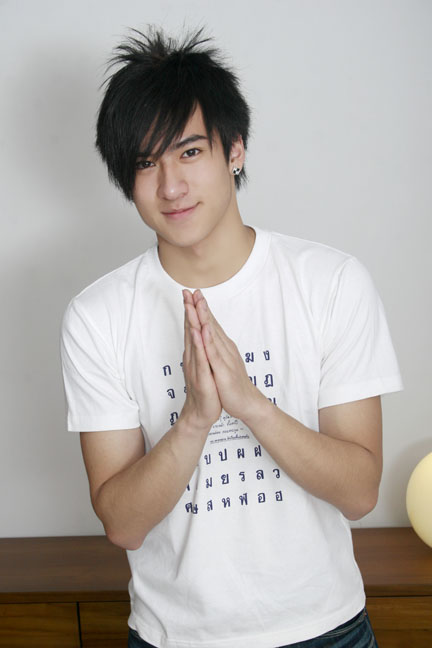
Name : Shen Jian Hong Country : Taiwan Date Of Birth : 9th November 1992 Height : 170CM Profession : Singer
Though still in his teens, he has become a devout Buddhist and has recorded Buddhist theme songs. Unlike most Buddhist hymms, his songs are contemporary songs but incorporated with the Dhamma. He said that he wanted to spread the dhamma to young people through his songs.
He caught the attention of Master Hsing Yun of Fo Guang Shan with one of his performances. Master Hsiung Yun praised the young Shen Jianhong for his unique style of singing and this eventually led to the making of a music video with Shen Jianhong singing about the Dhamma in rap.
The shooting of the MV was done outdoor, in the compound of Fo Guang Shan temple. During shooting, there was a heavy downpour, prompting the director to halt the session.
Shen Jianhong ran into the main shrine of the temple, knelt before the Buddha and prayed for the rain to stop. To the astonishment of everyone, the rain suddently stopped and shooting was continued but shortly the shooting had ended, it startd to rain heavily again. Everyone there thought that Shen Jianhong must have received blessing from the Buddha.
This is the MV where it's shooting was halted due to heavy rain